MeTime
A mental-wellbeing companion that asks less of people who are already depleted.
- Project type
- Individual concept
- Origin
- 2020 · Remote-work wellbeing
- My focus
- Product & interaction thinking
- Status
- Prototype · Unvalidated
Support should feel like relief.
MeTime began as an individual concept for employee wellbeing during remote work in 2020. Watching colleagues and people around me struggle with exhaustion, isolation and poor sleep prompted a question: how could support feel easier to reach?
The observations were informal, drawn from colleagues, friends and personal experience. They were not formal interviews or a clinical research study. The project is presented as product and interaction thinking.
How do you make asking for support cost almost nothing?
Design for the lowest-energy moment.
A wellbeing product can become another task: log a mood, finish an exercise, keep a streak. For someone already depleted, even a useful action has a cost.
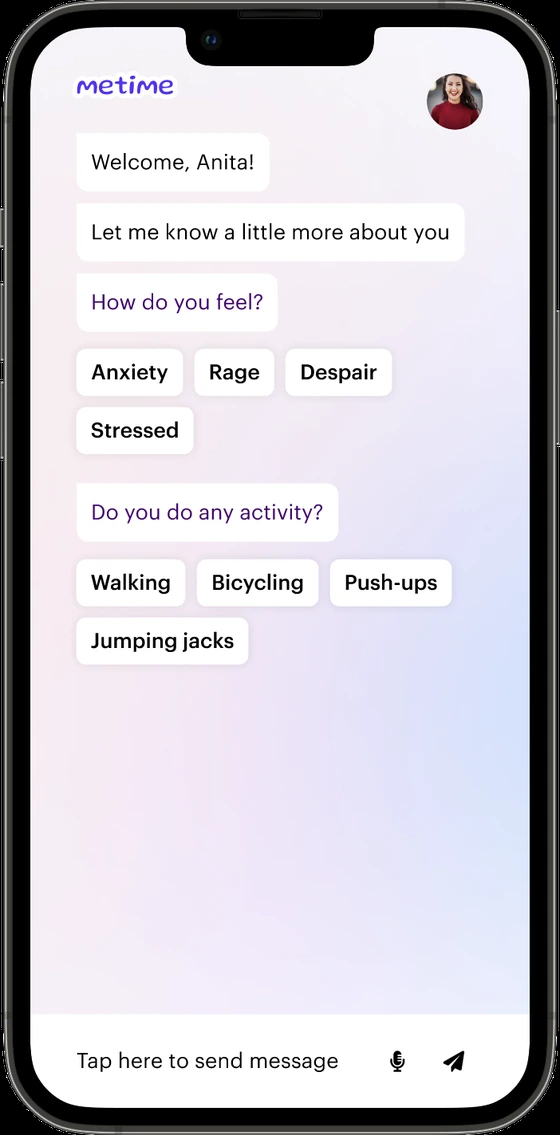
The design principle was to reduce the effort required to receive emotional support. The companion asks how a person feels and what they enjoy, then offers different pathways rather than prescribing one method.
A conversation, not a form
Conversational onboarding collects mood, activities and interests in small steps. The intent is to help suggestions feel relevant without presenting a large library to search.
Different people, different comforts
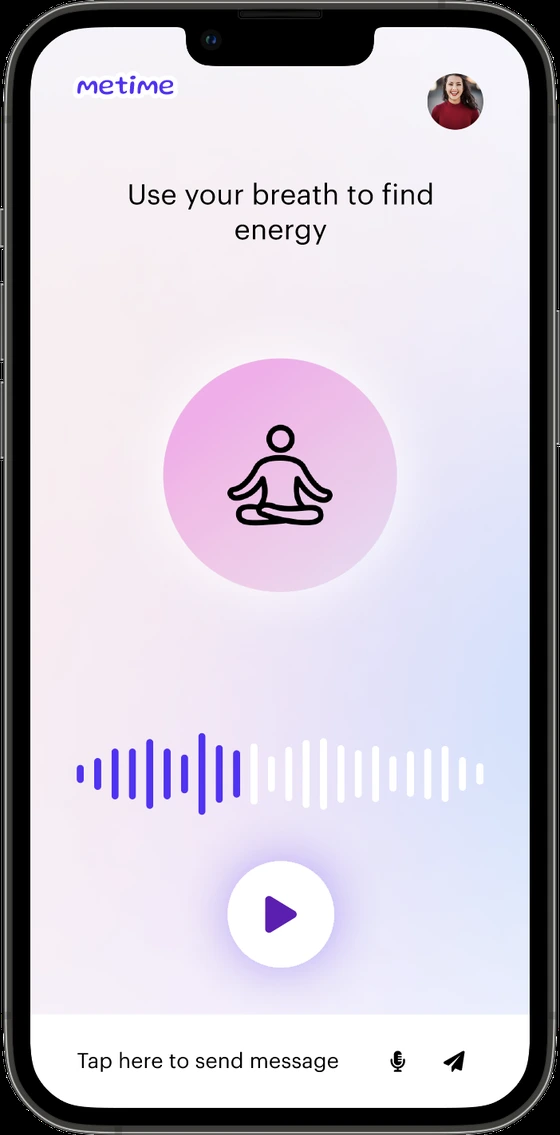
The concept offers pathways such as music, meditation, conversation and creative expression. Choice supports different coping preferences; it also creates a challenge in keeping the experience focused.
Give every suggestion an exit
“Not in the mood”, “Suggest something else” and “End this session” make leaving as easy as starting. Completion is never the only successful outcome.
Keep text and voice together
Voice sits beside text in the interface as an alternative for people who are tired of typing or looking at a screen. This is a concept-level intent, rather than a fully implemented accessibility solution.
A mood that colours itself.
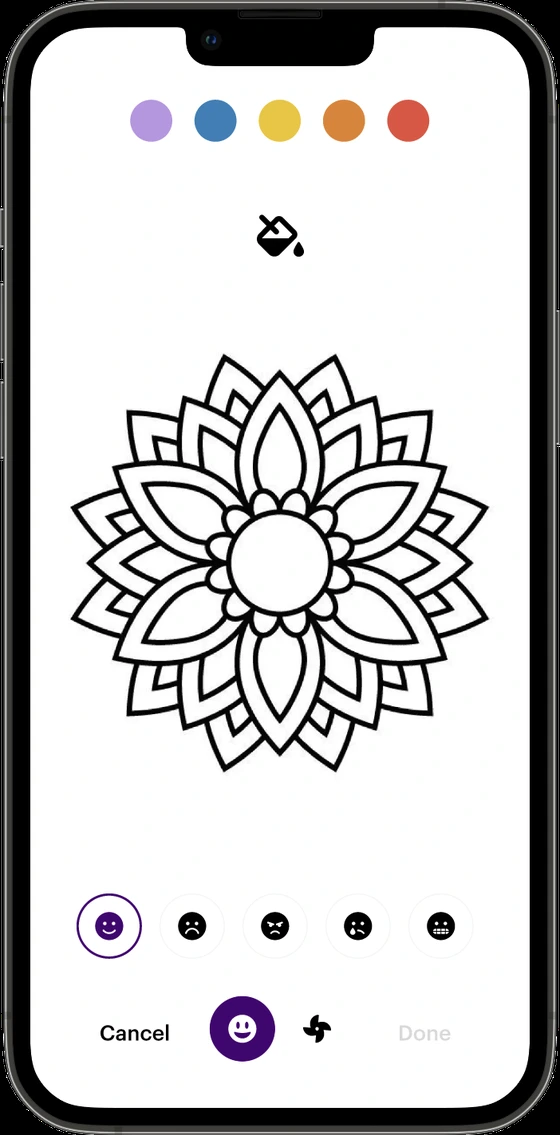
One creative pathway is a colouring mandala. Its palette responds to the selected mood: muted tones for a heavier mood, brighter tones for a lighter one. Colour becomes part of the interaction rather than surface decoration.
This is also the decision I would validate first. Asking a depleted person to colour could contradict the low-effort principle. I would test whether people choose it over lighter pathways and whether the palette feels appropriate.
Gentle suggestions. Graceful exits.
The original prototype pairs conversational prompts with soft colour, simple controls and multiple ways to respond. The important detail is the permission to choose another path.
Keep the principle. Test the assumptions.
The next step would be to test whether mood-matched suggestions feel relevant, which pathways people choose when tired, and whether the mandala helps or asks too much. Adaptive logic, accessibility and clear boundaries would need further work.
MeTime is a companion concept, not a clinical service. It has no validated wellbeing outcomes, and no usage or engagement metrics are claimed here.
Make the helpful thing easier to receive.