ACME Connect
Turning enterprise complexity into a unified employee experience.
Work, with
less friction.
Original product screens from the ACME Connect case study.
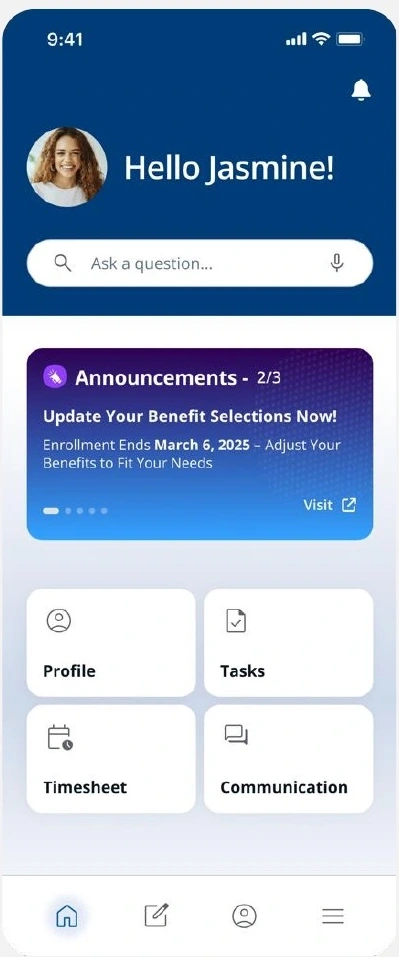
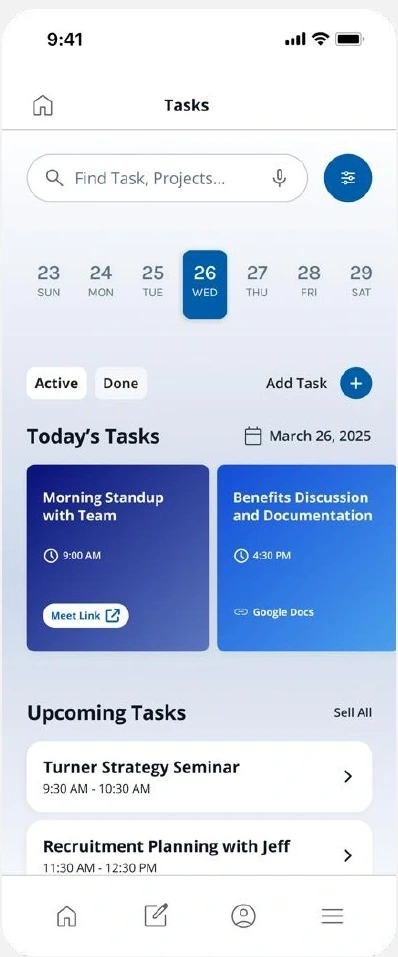
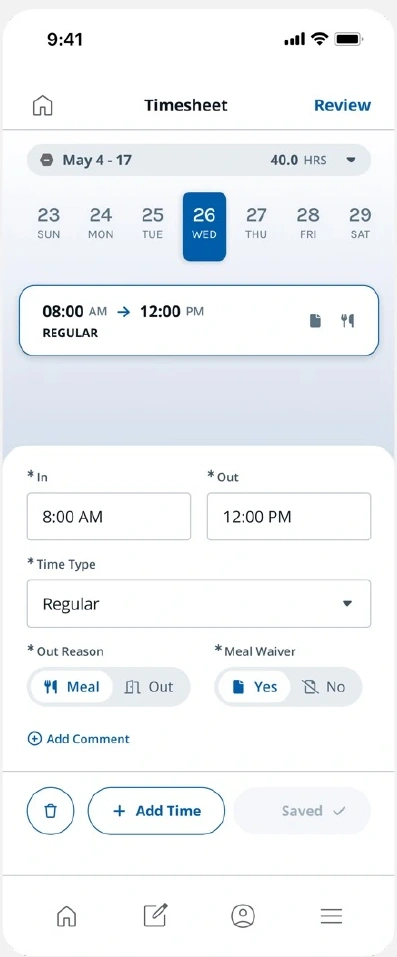
- My role
- UX Design Lead
- Duration
- 6+ months
- Audience
- 10,000+ associates
- Scope
- Research · IA · System · Delivery
One workday. Too many disconnected systems.
Associates moved between separate systems for timesheets, leave, benefits, payslips and learning. Each task brought a different entry point. For people working in the field, inconsistent mobile access made those everyday tasks harder.
ACME Connect brought these services together in an AI-driven employee experience platform for 10,000+ office and field associates, across responsive web, iOS and Android.
of 1,000 surveyed associates reported difficulty navigating the existing platform.
reported logged-hour errors that contributed to payroll inaccuracies.
These figures describe the starting problem documented in the case study, rather than post-launch improvements.
Leading the structure, the system and the delivery.
As UX Design Lead, I worked across product, engineering, QA, scrum and UX teams. My responsibilities covered strategy, information architecture, production-ready visual design, system governance and sprint-based delivery.
- Research & structure: stakeholder workshops, requirements clarification, card sorting and usability validation.
- Visual design & prototyping: flows, wireframes, interface design and screen states.
- Design governance: atomic components, tokens, icon standards, peer review and a clear sign-off path.
- Team leadership: mentoring, client alignment, Azure DevOps handoffs and cross-functional knowledge sharing.
Create alignment before adding more screens.
Make IA a formal first step
Navigation was unresolved, which kept sending screens back into iteration. I raised the gap and ran open and closed card-sorting in Miro with the client’s designer. The result was an approved structure and a shared blueprint for the team.
Give the design system an owner
Components and icon styles had drifted across designers. I built an atomic system and introduced approvals, unified sizing and iconography, plus peer review before development handoff.
Simplify the first interaction
Two app-store QR codes complicated rollout. I proposed one device-aware QR deep link to route associates to the appropriate store. The team adopted the idea.
Make knowledge travel across teams
I led the first design-system knowledge-transfer session, then rotated facilitation through backend, QA and DevOps. The aim was a shared understanding of the whole product, beyond individual roles.
A consistent language for everyday work.
A restrained navy and blue palette, common components and unified interaction patterns connected the platform’s different tasks. Mobile-first layouts kept frequent actions close, while AI Q&A provided another entry point to the experience.
A launched platform. A foundation for what comes next.
The mobile and web experience launched in production, unifying access to employee self-service tasks. The validated IA and governed design system gave design, engineering and QA a clearer shared foundation for ongoing delivery.
The lesson I carry forward: identifying the missing structure, ownership or connection can be more valuable than simply executing the next screen.
The best design leadership makes the work clearer for everyone.
ACME Connect is an anonymised enterprise project. This narrative is based on the original case-study presentation.